
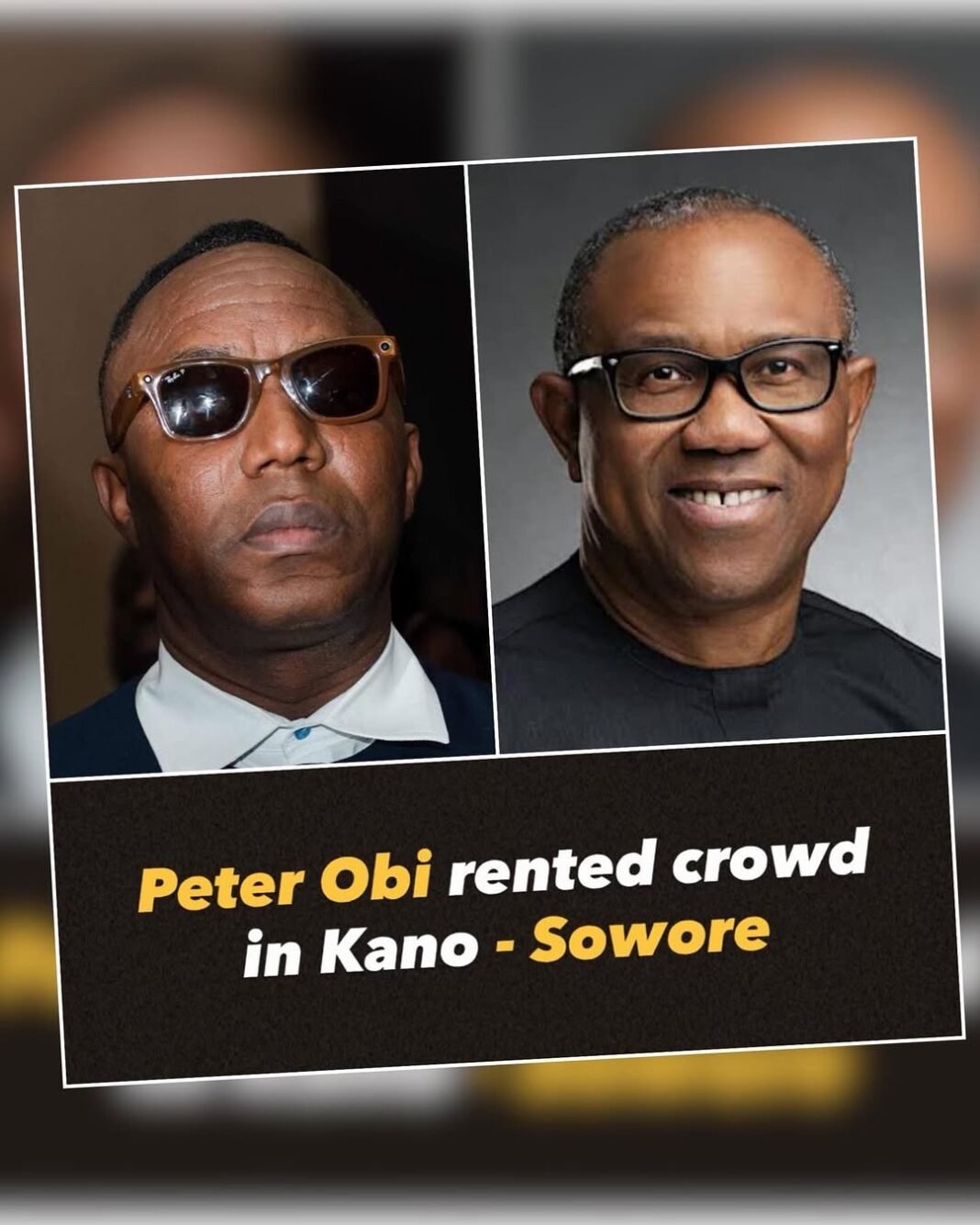
In the landscape of Nigerian opposition politics, few voices are as piercing as that of Omoyele Sowore. The AAC presidential candidate and veteran activist has never been one to mince words, and his latest target is a familiar one: the Labour Party’s Peter Obi.
The latest friction comes following Peter Obi’s recent high-profile visit to Kano, where he met with Rabiu Musa Kwankwaso and engaged with local supporters. While the “Obidient” camp viewed the visit as a masterstroke in building a 2027 coalition, Sowore has dismissed the optics as nothing more than a carefully manufactured performance.
The Allegation: “Rented” Support?
Sowore’s primary claim is a heavy one: that the enthusiastic crowds seen around Peter Obi in Kano were not “organic” supporters, but rather a “rented” audience common in traditional Nigerian political rallies.
For Sowore, this isn’t just a petty insult; it’s a critique of what he calls “transactional politics.” He argues that if a leader truly represents the people, they shouldn’t need to mobilize crowds through logistics and incentives. He points to his own history of protests and activism as the standard for “authentic” engagement, contrasting it with what he sees as the “staged” nature of the Labour Party’s movements in the North.
“He Wasn’t Ready to Fight”
Beyond the crowd allegations, Sowore has been vocal about his disappointment with Peter Obi’s post-2023 conduct. In a recent session, Sowore claimed he had originally volunteered to lead protests to defend the 2023 mandate, but that Obi “wasn’t ready to fight.”
Sowore’s narrative is clear: he views Peter Obi as part of the “establishment” rather than a true revolutionary. By calling out the Kano crowd, Sowore is attempting to pull back the curtain on the “organic” brand that Peter Obi has built, suggesting that when the cameras aren’t rolling, it’s just the same old political machinery at work.
The Counter-Argument: Building Bridges
On the other side, supporters of Peter Obi argue that his visit to Kano—specifically his meeting with Kwankwaso during the Sallah celebrations—is about national unity and “bridge-building.” They see Sowore’s critiques as a distraction from the larger goal of unseating the current administration. To them, the “crowds” in Kano are a sign that Obi’s message is finally breaking through the tribal and regional barriers that have traditionally hampered southern candidates in the North.
The Verdict
The tension between Sowore and Obi highlights a fundamental split in the Nigerian opposition:
• The Sowore School: Believes in a “Revolution Now” approach where the system is completely dismantled from the outside.
• The Obi School: Believes in working within the existing political structure to bring about incremental, systemic change.
Whether the Kano crowd was “rented” or “organic” may depend on which side of the political divide you stand on. However, one thing is certain: as the road to 2027 begins to take shape, the battle for the “soul of the opposition” is only going to get louder.


