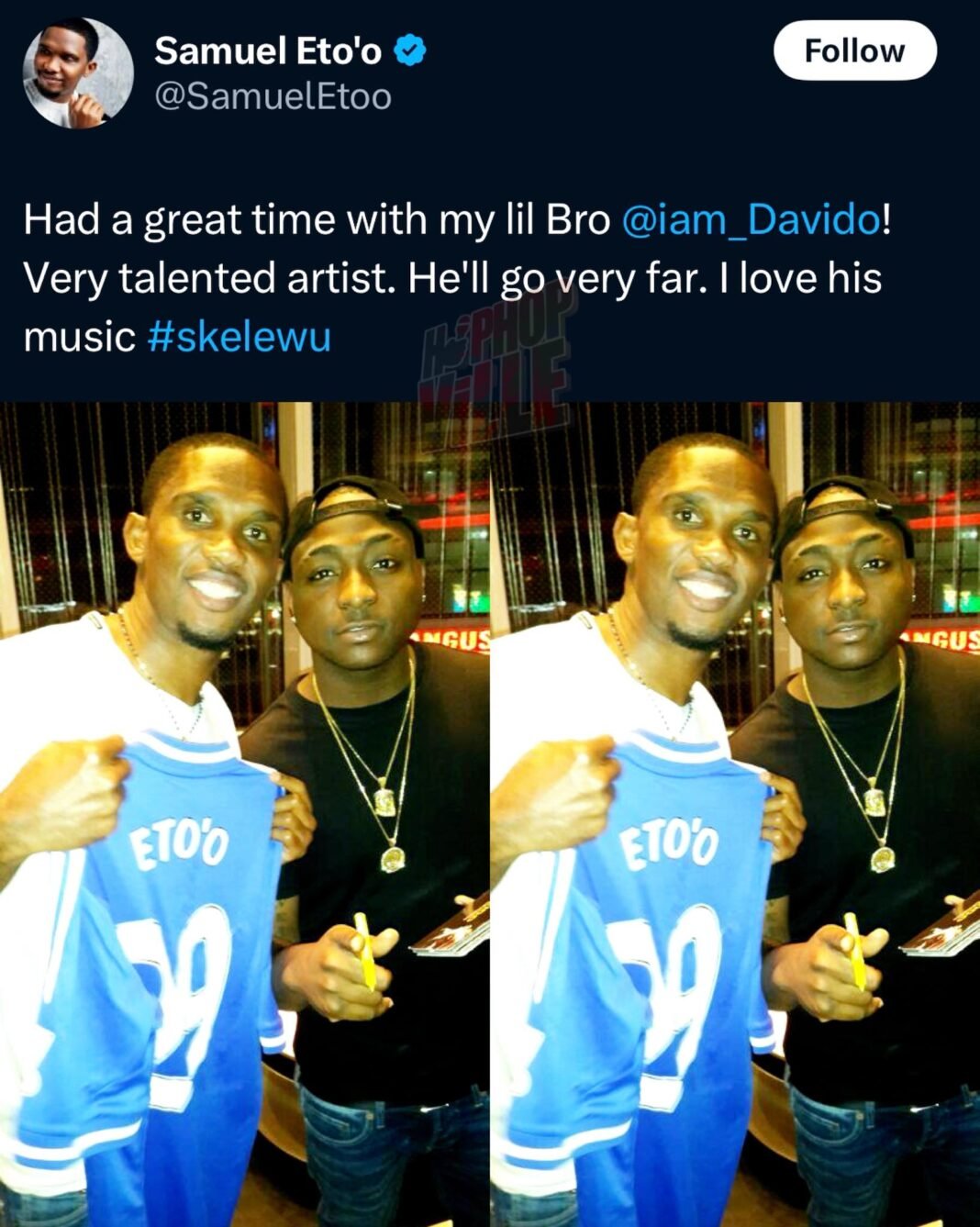
Some images just stick in the cultural consciousness, and a legendary photo of African football superstar Samuel Eto’o alongside Nigerian AfroBeats sensation Davido has once again surfaced, sending fans into a frenzy of nostalgia.
This iconic snapshot is more than just two celebrities meeting; it’s a moment that captures the exact instant a global musical trend was born.
The Backstory of the Post
Re-shared this week, the post features Samuel Eto’o’s genuine admiration for his “lil Bro,” Davido. In the original caption, Eto’o didn’t hold back, writing: “Had a great time with my lil Bro @iam_Davido! Very talented artist. He’ll go very far. I love his music #skelewu”.
Eto’o, known for his legendary skills at clubs like Barcelona and Inter Milan, was showing his support for the next generation of African talent. His prediction that Davido would “go very far” was, in hindsight, an understatement.
The #Skelewu Connection
The image features Davido presenting a blue #29 Eto’o jersey, presumably from Eto’o’s time with clubs like Chelsea or Everton. Davido, already holding his own celebrity status in a black t-shirt and gold chains, is seen holding a pen, likely moments away from autographing an item.
But the real magic lies in the hashtag: #skelewu.
When this photo was first posted, “Skelewu” was the hottest song in Africa. The accompanying dance—a simple, sliding movement—was taking over social media. Eto’o’s endorsement was not just a friendly shout-out; it was a powerful verification from one of Africa’s most respected figures, helping to launch Skelewu and Davido into the global stratosphere.
Why this Moment Matters in 2026
Today, this photo is a testament to the powerful synergy between African football and music. It’s a moment of cross-cultural validation where a sporting idol helped amplify a musical trend.
Looking back, we can see how right Eto’o was. Davido has indeed “gone very far,” becoming one of the most successful and influential artists on the planet. This throwback isn’t just about two famous faces; it’s a visualization of the early days of Africa’s global cultural takeover.